How Is Mental Age Determined? Formulas, Quizzes, and Real Limits
How is mental age determined? The honest answer is that it depends on what someone means by "mental age." In older intelligence testing, it described how a child's test performance compared with the average performance of children at different ages. In modern online quizzes, it is usually a playful estimate based on preferences, decision-making style, emotional reactions, and self-reflection patterns. If you want a light, anonymous way to explore the idea, a free mental age test can be a useful starting point, as long as you treat the result as personal insight rather than a clinical label.

The Short Answer: Mental Age Is a Comparison, Not a Fixed Trait
Mental age is best understood as a comparison. It does not mean your mind literally belongs to a different birthday. It means a set of responses, skills, or habits is being compared with an age-related reference point.
In a formal testing history, that reference point was age-normed performance: a child answered tasks, the raw score was compared with what children of different ages typically achieved, and the result was expressed as an age level. In casual self-reflection tests, the reference point is more interpretive. Your answers are grouped into patterns that resemble different life stages, such as playful curiosity, practical responsibility, cautious reflection, or old-soul steadiness.
That is why two people can ask the same question and mean very different things. A student searching "how is mental age determined quizlet" may be looking for the old formula used in a class. A person using a mental age calculator may be asking how a quiz turns answers into a result. Both questions are valid, but the answer changes with the context.
How Mental Age Was Determined in Early IQ Testing
Historically, mental age came from performance on age-graded intelligence tasks. If an average 10-year-old could solve a certain level of problems, and a younger child solved that same level, the younger child might be described as having a mental age of 10 for that test.
The familiar old IQ formula was:
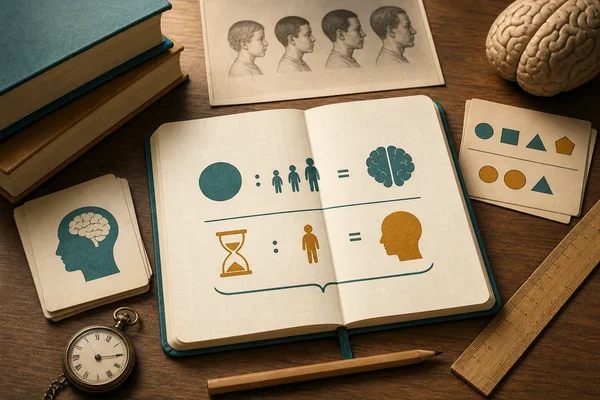
IQ = mental age / chronological age x 100
Chronological age is the number of years someone has lived. Mental age, in this older formula, was the age level linked to the person's test performance. If a 10-year-old had a mental age of 12 on a test, the ratio would be 12 / 10 x 100, or 120. If a 10-year-old had a mental age of 7 on that same kind of formula, the ratio would be 7 / 10 x 100, or 70.
That simple equation explains why people often ask, "What mental age is a 70 IQ?" In the historical ratio model, you would multiply chronological age by the IQ ratio. For a 10-year-old, 70 IQ would map to a mental age of about 7. For a 14-year-old, the same ratio would map to about 9.8. This is a math example, not a complete picture of a person.
Why Modern IQ Scores Are Different
Modern IQ testing generally does not use the old mental-age divided by chronological-age formula as the main scoring method. Contemporary tests are standardized against age groups and report how a person's performance compares with a representative sample. In everyday language, people still say "IQ," but the score is usually about relative standing within an age group, not a literal mental-age calculation.
This matters because ability does not grow in a perfectly straight line. A gap of two years means something different at age 6 than it does at age 16. Adults also do not keep gaining "mental age" in the same simple way that children gain chronological age. For that reason, mental age is much more limited than many quick charts make it seem.
How Mental Age Is Determined in Children
When the phrase is used with children, it usually refers to age-level comparison. A test or task set asks what a child can do, then compares that performance with the average performance of children at different ages. The result may be described as an age-equivalent score, a developmental level, or a mental-age-style estimate.
Even then, the result should be read carefully. A child may reason verbally like an older child, handle frustration like a younger child, and show social confidence that depends heavily on environment. One number can flatten those differences. It is more helpful to ask, "Which skills does this result describe?" than "What age is this child really inside?"
That is also why questions like "what is the mental age of a 13 year old" or "what is the mental age of a 14 year-old" do not have one universal answer. In a historical average sense, a typically scoring 13-year-old would have a mental age near 13, and a typically scoring 14-year-old would have a mental age near 14. In a casual quiz, however, a 14-year-old might receive a younger or older inner-age result based on personality-style answers, not measured ability.
How Online Mental Age Quizzes Estimate a Result
Online mental age quizzes usually work very differently from formal intelligence tests. They ask about everyday preferences, reactions, habits, and scenarios. Then they assign those answer patterns to age-like profiles. For example, a quiz might look at how you approach risk, how you make plans, whether you prefer novelty or routine, and how you respond to social tension.
A thoughtful quiz may consider several broad areas:
- Decision style: spontaneous, careful, flexible, or long-range.
- Emotional maturity: how you pause, reflect, and handle disagreement.
- Social energy: playful, independent, nurturing, reserved, or balanced.
- Curiosity and openness: whether you seek new experiences or familiar comfort.
- Responsibility cues: how you think about time, money, commitments, and goals.
None of these areas proves a person's intelligence or worth. They simply create a reflective profile. If you use an online mental age quiz, the most useful question is not "Is this number perfectly true?" It is "Which parts of the result feel familiar, and which parts make me think?"

A Mental Age Example from a Quiz
Imagine two people choose different answers to the same situation: a friend cancels plans at the last minute. One person feels disappointed but quickly adapts and finds something fun to do. Another person calmly checks in, asks if everything is okay, and reschedules with little frustration.
A quiz might interpret the first response as youthful flexibility and the second as mature emotional regulation. Neither response is "better." They simply point to different styles. A mental age example like this shows why quiz results are more like personality-flavored reflections than hard measurements.
What a Mental Age Chart or Calculator Can Tell You
A mental age chart can be useful when it shows the logic behind an estimate. In the old IQ context, a chart might show how chronological age, mental age, and ratio IQ relate mathematically. In a quiz context, a chart might show which response patterns are associated with younger, same-age, or older inner-age profiles.
The problem comes when a chart pretends to be more exact than it is. A calculator can make a number look precise, but precision is not the same as meaning. If a calculator says your mental age is 17, that does not mean a professional would describe your mind with that exact number. It may simply mean your answers leaned toward traits the quiz associates with late-teen independence, curiosity, or emotional intensity.
Average mental age also depends on the system. In the historical ratio model for children, an average result often meant mental age roughly matched chronological age. In an entertainment quiz, the "average" may be the most common result among users or the midpoint of the scoring system. Those are not the same thing.

How to Read a Mental Age Result Without Overreading It
The safest way to read any mental age result is to treat it as a mirror, not a verdict. You can use the number to notice patterns, but you do not need to turn it into an identity.
Try this simple reflection checklist:
- Separate the number from the insight. Ask what the result says about your habits, not whether the age sounds flattering.
- Look for patterns across situations. Do you show the same style at work, with friends, and under stress?
- Notice strengths first. A younger inner age may suggest playfulness and openness. An older inner age may suggest patience and perspective.
- Leave room for change. Your reactions can shift with experience, stress, sleep, relationships, and deliberate practice.
- Seek qualified support for serious concerns. If a result raises worries about learning, mood, memory, or daily functioning, a qualified professional can offer more appropriate guidance than an online quiz.

A Thoughtful Way to Explore How Your Mental Age Is Determined
If you are curious about how your mental age is determined, start by choosing the right frame. For school or IQ history, focus on the old ratio formula and its limits. For children, focus on age-level comparison within specific skills. For online quizzes, focus on answer patterns and self-reflection rather than exact measurement.
MentalAgeTest.me is built around that lighter, reflective use case. The result is meant to be interesting, shareable, and thought-provoking, not a professional assessment. You can explore your inner age through a playful quiz and then use the result as a prompt: What feels accurate? What feels surprising? What would you like to understand about yourself next?
The best outcome is not proving that you are secretly 13, 17, 30, or 70 inside. It is noticing how you think, how you react, and how you relate to change. That kind of curiosity is where a mental age self-reflection tool can be most useful.
FAQ
How is your mental age determined?
In older intelligence testing, mental age was determined by comparing a child's test performance with the average performance of children at different ages. In online quizzes, it is usually estimated from patterns in your answers about choices, emotions, preferences, and daily habits.
What is mental age in IQ?
In the historical ratio formula, IQ equaled mental age divided by chronological age, then multiplied by 100. So a child whose mental age matched chronological age would score 100 in that model. Modern IQ tests usually compare performance with age-group norms instead of using that simple formula.
What is the mental age of a 13 or 14 year old?
In the old average-performance sense, a typically scoring 13-year-old would be close to a mental age of 13, and a typically scoring 14-year-old would be close to 14. In a fun quiz, the result can be younger or older because it reflects answer patterns, not a formal age-equivalent score.
What mental age is a 70 IQ?
Using the historical ratio formula, mental age equals chronological age multiplied by IQ and divided by 100. For example, at age 10, a 70 IQ ratio would equal about 7 years. This is only a formula example and should not be used as a full description of someone's abilities or support needs.
What are signs of a high mental age?
In casual language, a high mental age may point to traits such as patience, long-term thinking, emotional steadiness, comfort with responsibility, and reflective decision-making. It does not mean someone is better or smarter. It simply suggests an older-style response pattern in that context.
Is a 72 IQ or 60 IQ "dumb"?
No. "Dumb" is a hurtful and unhelpful label. IQ scores, when measured by qualified professionals, are only one piece of information about certain cognitive tasks. They do not define a person's dignity, personality, creativity, kindness, practical skills, or future.
Can you increase your IQ or mental age?
You can build skills, knowledge, emotional regulation, and problem-solving habits over time. IQ scores are designed to be relatively stable, but performance can be affected by education, health, sleep, stress, practice, and testing conditions. A quiz-style mental age can also shift as your habits and self-perception change.