How to Calculate Mental Age Without an IQ Score
If you want to know how to calculate mental age without an IQ score, the first thing to clear up is what kind of "mental age" you mean. In older intelligence testing, mental age was tied to IQ formulas. In today's online culture, it usually means something lighter: a way to reflect on your thinking style, emotional maturity, preferences, and how you respond to everyday situations. Without an IQ score, you cannot calculate a clinical or standardized mental age. You can, however, make a thoughtful estimate for self-reflection by looking at patterns in behavior, decision-making, and emotional responses. A free mental age test for self-reflection can be a simple starting point, as long as you treat the result as a conversation starter rather than a fixed label.

Why IQ Is Not Required for a Self-Reflection Estimate
The classic IQ-based formula is simple on paper: mental age equals chronological age multiplied by IQ, then divided by 100. That formula belongs to an older way of thinking about intelligence testing. It is useful to know because many people still search for "how to calculate mental age for IQ," but it is not the best fit for modern self-discovery quizzes.
If you do not have an IQ score, do not try to invent one. IQ testing is a structured process, and a casual guess would only make the final number look more precise than it is. For an at-home reflection, the better question is not "What exact age is my mind?" but "Which life-stage patterns do my choices resemble right now?"
That shift matters. A self-reflection estimate can look at how you plan, handle stress, balance fun and responsibility, learn from mistakes, relate to other people, and respond to change. These areas do not replace intelligence testing. They simply give you a more practical snapshot of how you tend to move through daily life.
A Practical At-Home Method for Estimating Mental Age
To calculate mental age at home without an IQ score, use a pattern-based method instead of a formula. The goal is to compare your answers with broad life-stage themes, then interpret the result with humility.
Start with five reflection categories:
- Decision-making: Do you usually act on impulse, weigh a few options, or create a structured plan?
- Emotional response: When plans change, do you react quickly, pause to reset, or adapt calmly?
- Responsibility style: Do you avoid routines, balance duties with fun, or prefer long-term stability?
- Curiosity and learning: Do you seek novelty, practical growth, deep reflection, or familiar comfort?
- Social outlook: Do you value excitement, belonging, independence, mentoring, or quiet connection?
For each category, choose the description that feels most like your usual pattern, not your best day or worst day. Then map the pattern to a broad range:
| Pattern | Reflection range | What it may suggest |
|---|---|---|
| Highly playful and novelty-seeking | Teen to early twenties | You may value spontaneity, quick excitement, and flexible identity exploration. |
| Balanced but still experimenting | Twenties to thirties | You may be mixing independence, ambition, relationships, and personal growth. |
| Stable and responsibility-oriented | Thirties to forties | You may prefer planning, reliability, and thoughtful tradeoffs. |
| Reflective and settled | Forties plus | You may value perspective, emotional steadiness, and deeper meaning. |
This is not a scorecard for being better or worse. A lower estimated mental age does not mean less intelligence. A higher estimated mental age does not mean superiority. It only points to the mood and maturity signals your current habits may express.
If you want a more guided version, a mental age test experience can help organize these questions into a quicker flow. The important part is still interpretation: notice the pattern, then ask whether it feels useful.
How to Build a Simple Mental Age Calculator Without IQ
A mental age calculator without IQ can be built around weighted self-report questions. You can create one on paper, in a spreadsheet, or just in a notes app.
Use 12 questions across the five categories above. Give each answer a point value from 1 to 4:
1 means youthful, spontaneous, and novelty-led. 2 means flexible, social, and still exploring. 3 means practical, balanced, and responsibility-aware. 4 means reflective, steady, and long-view oriented.
For example, ask: "When a weekend suddenly opens up, what do I usually choose?" A 1-point answer might be "I want an unexpected adventure." A 2-point answer might be "I want to see friends but keep some downtime." A 3-point answer might be "I catch up on tasks and make room for one enjoyable activity." A 4-point answer might be "I prefer quiet reflection, reading, or meaningful conversation."
After 12 questions, total the points:
| Total score | Estimated reflection range |
|---|---|
| 12-20 | Youthful / teen-to-early-twenties style |
| 21-30 | Young adult / flexible growth style |
| 31-40 | Mature adult / balanced responsibility style |
| 41-48 | Reflective adult / settled perspective style |
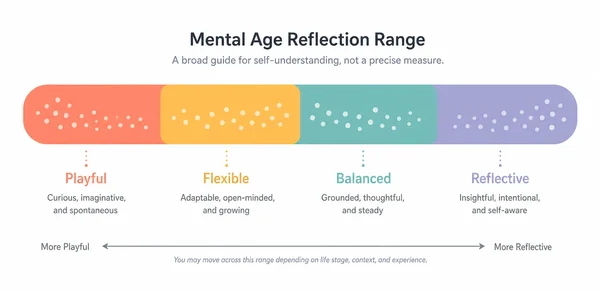
This calculator is intentionally broad. It should not claim precision down to an exact year. Saying "my pattern feels young adult-like" is more honest than saying "my mental age is exactly 27." The broader language also helps you avoid turning a fun reflection into a rigid identity.
How to Estimate a Child's Mental Age Carefully
Searches such as "how to calculate mental age of a child" need extra care. A child is still developing quickly, and children vary widely in language, attention, emotional regulation, social comfort, and learning pace. A casual online mental age chart should not be used to judge a child's ability or future.
For a light, non-clinical reflection, parents and caregivers can observe age-appropriate patterns:
- Communication: Does the child express needs, feelings, and ideas in a way that roughly matches their age group?
- Problem-solving: Do they try strategies, ask for help, or give up quickly?
- Emotional regulation: How do they recover from frustration, disappointment, or sudden changes?
- Independence: Which everyday tasks can they attempt with reasonable support?
- Social play: Do they engage in parallel play, cooperative play, leadership, negotiation, or quiet observation?
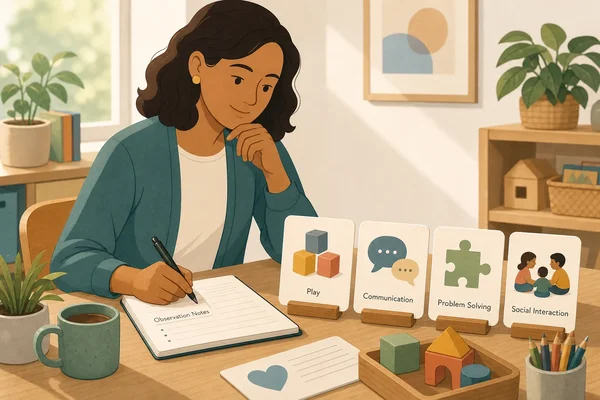
These observations can support better conversations with teachers, caregivers, or professionals if concerns arise. They should not be used to label the child. If a child's development, learning, mood, or safety feels concerning, seek qualified guidance rather than relying on an online calculator.
Reading a Mental Age Chart Without Overthinking It
A mental age chart can be helpful when it explains broad patterns, but it becomes misleading when it pretends that every age has one correct personality. Real people are mixed. You might be playful in friendships, careful with money, emotionally steady in conflict, and adventurous when traveling. Which one is your "real" mental age?
That is why the best chart is a conversation tool, not a final answer. Use it to ask:
- Which traits feel familiar?
- Which traits feel outdated or too simple?
- Which pattern appears only when I am stressed?
- Which pattern appears when I feel safe and energized?
- What would I like to practice next?
For example, someone who asks "what is the mental age of a 14 year-old?" may be looking for a direct number. A 14-year-old's chronological age is 14, but their emotional maturity, decision-making, and social confidence can vary a lot. A better answer is that teenage mental-age patterns often involve identity exploration, stronger peer influence, emotional intensity, and growing independence. Those traits can show up in adults too, especially in playful or high-stress situations.
Common Mistakes When Calculating Mental Age Without IQ
The biggest mistake is treating a mental age estimate like a serious measurement. Without a standardized assessment, you are working with self-report patterns. That can be useful, but it is not exact.
Another mistake is confusing mental age with intelligence. A person can be brilliant and playful. Another person can be calm, careful, and still struggle with certain kinds of reasoning. Mental age, especially in online quizzes, is more about style than capacity.
A third mistake is assuming the result is fixed. Your mental age estimate can shift with stress, relationships, work demands, sleep, major life events, and the questions being asked. If one free mental age test gives a different answer from another, that does not automatically mean one is wrong. They may be weighting different traits.
Finally, avoid using harsh labels. If someone asks whether an IQ of 80 means a person is "dumb," the respectful answer is no. IQ scores are limited snapshots from specific tests. They do not capture kindness, creativity, practical wisdom, resilience, humor, motivation, or the full range of human ability.
Use the Estimate as a Reflection Prompt, Not a Label
The safest way to calculate mental age without an IQ score is to call it what it is: a reflective estimate. You can compare your everyday patterns with broad life-stage themes, use a simple scoring system, or explore an anonymous self-reflection tool for a more guided experience. Just keep the result flexible.
After you get an estimate, ask three follow-up questions:
- Which part of this result feels accurate?
- Which part feels too simplistic?
- What small habit would help me grow in the direction I actually want?
That last question is the real value. A mental age number may be fun to share, but the reflection behind it can be more useful. It can show where you crave more play, where you want more patience, where you are already steady, and where you might want to experiment with a new way of responding.
FAQ
How do you calculate mental age?
Historically, mental age was connected to IQ formulas. For modern self-reflection, you can estimate it by comparing your decision-making, emotional responses, responsibility style, curiosity, and social outlook with broad life-stage patterns. This gives a flexible reflection range, not an exact measurement.
How do you convert IQ to mental age?
The older formula is mental age equals chronological age multiplied by IQ, divided by 100. For example, a chronological age of 10 and an IQ of 110 would imply 11 years in that historical ratio model. Modern IQ scoring does not rely on that simple conversion in the same way, so use the formula only as historical context.
How can I measure intelligence without IQ?
You cannot fully measure intelligence with one casual method. You can explore different strengths, such as problem-solving, memory, creativity, learning speed, emotional awareness, practical judgment, and communication. For serious educational or psychological questions, a qualified professional can use structured tools and context.
Is an IQ of 80 considered dumb?
No. "Dumb" is a harsh and unhelpful label. An IQ score is only one test-based snapshot and does not define a person's worth, potential, kindness, creativity, work ethic, or practical strengths. If a score raises real-life concerns, it is better to discuss the context with a qualified professional.
Can I calculate mental age online for free?
Yes, you can use a free online mental age test as a light self-reflection activity. Treat the result as a fun prompt, not a scientific conclusion. Different tests may give different results because they ask different questions and weight traits differently.
What is the best way to calculate mental age without an IQ score?
The best approach is a broad pattern estimate. Look at how you make decisions, handle stress, balance responsibility and fun, learn from experience, and connect with others. Then place the pattern in a flexible range instead of forcing an exact age.
Can mental age change over time?
Yes, a self-reflection estimate can change. Life experience, stress, relationships, learning, health, work, and new habits can all affect how mature, playful, cautious, or reflective you feel and behave. That flexibility is one reason mental age is best used as a reflective idea rather than a permanent label.