How to Determine Your Mental Age: The Ultimate Guide & Quiz
Have you ever met a 20-year-old who gives life advice like a retired philosopher? Or a 50-year-old who still approaches every weekend with the unbridled enthusiasm of a teenager? We all have a biological age based on our birth certificate, but our personalities often tell a completely different story.
This disconnect between the candles on your birthday cake and the way you actually feel inside leads many people to wonder how to determine mental age. Whether you suspect you are an "old soul" or you simply refuse to outgrow your youthful curiosity, understanding your mental maturity can provide fascinating insights into how you make decisions, handle emotions, and interact with the world around you.
What Does Mental Age Actually Mean?
Before diving into how to calculate it, it is helpful to understand what the term actually implies. Mental age is a concept used to describe a person's level of cognitive ability, emotional maturity, and lifestyle preferences compared to the average expectations for a specific chronological age.
Chronological Age vs. Mental Age: Understanding the Difference
Your chronological age is simply the number of years you have been alive. It dictates when you can vote, drive, or retire. It moves forward at a constant rate, regardless of your life experiences.
Your mental age, often referred to interchangeably in pop culture as your psychological age vs chronological age, is much more fluid. It represents how you think. It encompasses your emotional regulation, your problem-solving skills, and your overall perspective on life. While a 30-year-old chronological age might be expected to have certain career and family milestones sorted out, their mental age could be much younger if they prioritize spontaneous play, or older if they hold deeply pragmatic, cautious views of the future.
The History and the Formula: How Mental Age Started
The modern fascination with mental age didn't start on social media; it actually has deep roots in early 20th-century psychology and the development of intelligence testing.
Alfred Binet and the Original IQ Calculation

The concept was introduced by French psychologist Alfred Binet. He was tasked with creating a test to identify students who needed educational assistance. By testing children with tasks of varying difficulty, Binet could determine a child's mental age based on the age group to which they performed similarly.
This led to the famous alfred binet mental age formula, which was historically used to calculate an intelligence quotient (IQ): (Mental Age / Chronological Age) x 100 = IQ.
For example, a 10-year-old child who passed the test for an average 12-year-old would have a mental age of 12 (and an IQ of 120). However, this mathematical formula to determine mental age is deeply flawed when applied to adults. Cognitive development doesn't follow the same linear trajectory at age 40 as it does at age 8. Because of this, modern psychology rarely uses this exact formula for adults.
Are You an 'Old Soul' or just 'Young at Heart'?
Today, when an adult searches for a way to find their mental age, they usually aren't looking for a sterile clinical score. Instead, they are looking for personality validation.
If your psychological maturity outpaces your physical years, you might be described as an "old soul." You likely value deep conversations over loud parties, prefer stability, and often find yourself exhausted by the drama of your peers. Conversely, being "young at heart" means you retain a childlike wonder. You might be more adaptable, creative, and willing to take risks, even if society tells you to "act your age."
How to Determine Your Mental Age Today (The Modern Quiz)
If the old mathematical formulas don't work for adults, how do you find out where you stand? Today, the answer is found in interactive, scenario-based assessments.
From Clinical Origins to Viral TikTok Trends
The desire for self-discovery has made the mental age quiz tiktok trend incredibly popular. People love sharing their surprising results with friends and followers. These modern quizzes skip the math and focus instead on evaluating your lifestyle preferences, conflict resolution styles, and emotional reactions to various scenarios.
Curious about your own inner maturity? Skip the math and take a fun, insightful assessment.
Start Your Mental Age Test Now
Why a Basic Number Isn't Enough: Get Your AI Insight Report
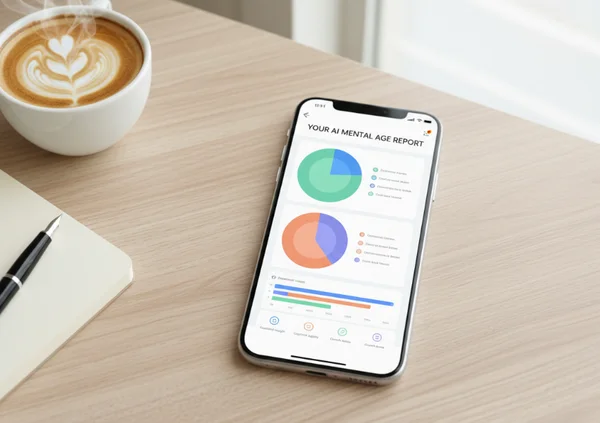
Many online quizzes are fun but superficial. They might tell you your mental age is 35, but they fail to explain why or what that means for your daily life.
At MentalAgeTest.me, we believe your mind is too complex for a single generic number. That is why we offer a unique, two-tiered experience. After answering a quick, free series of questions to get your baseline mental age, you have the option to unlock a deeply personalized, AI-driven analysis report.
This report doesn't just give you a number; it dives into your cognitive style, uncovers your emotional defense mechanisms, and provides tailored advice for your personal growth based on your specific patterns of answers. It transforms a simple viral quiz into a powerful tool for profound self-reflection.
Don't just settle for a generic number. Unlock a deeply personalized AI report detailing your cognitive and emotional traits.
Reveal Your True Inner Age Today
Frequently Asked Questions
What does a mental age of a teenager (e.g., 15) mean for an adult?
If a test suggests you have a teenage mental age, it doesn't mean you are unintelligent or incapable. Often, it points to a personality that is highly passionate, emotionally reactive, and driven by novelty. You may experience feelings more intensely than others and prioritize fun and social connection over rigid structure.
Is there a clinically accurate test for mental age?
For children, standardized intelligence tests are used to assess cognitive development. For adults, however, there is no single, clinically diagnostic "mental age" test used in modern psychiatry. Online quizzes are designed for entertainment, self-reflection, and personality exploration, not medical or psychological diagnosis.
Are social media mental age quizzes accurate?
Most viral social media quizzes are purely for fun and lack scientific validation. While they can accurately reflect the preferences you input (e.g., choosing early bedtimes results in an "older" score), they should be viewed as interactive prompts for self-reflection rather than rigorous psychological evaluations. Our AI-powered test aims to provide more nuanced insights than a standard social media quiz by thoroughly analyzing the patterns in your choices.