Mental Age Binet: What Alfred Binet Really Meant by Mental Age
If you searched for "mental age Binet," you are probably trying to connect two different worlds: Alfred Binet's early work on children's learning and today's much lighter mental age test culture. The phrase matters because Binet did not invent mental age as a personality label or a social media identity. He used it as a practical way to compare a child's problem-solving performance with the typical performance of children at different ages.
That historical meaning can still help you read modern mental age ideas more carefully. A reflective mental age test experience can be fun and personally useful when you treat the result as a prompt for curiosity, not as a fixed score about your worth, intelligence, or future.
Why Binet Created a Mental Age Test in the First Place
Alfred Binet and Theodore Simon developed the Binet-Simon test in France in the early 1900s for a practical school problem. Educators needed a better way to identify children who were struggling with ordinary classroom instruction and might need different support. The original goal was not to rank every child by value, predict their whole future, or turn intelligence into a permanent label.
That point is easy to miss because later intelligence testing became more formal, more statistical, and more controversial. Binet's starting question was narrower: can a set of tasks help adults understand whether a child is performing around the level expected for their age group? The Binet-Simon test used varied tasks involving memory, attention, language, reasoning, and everyday judgment. It was built around observed performance, not around a claim that the mind could be reduced to one simple number.
In other words, the Alfred Binet mental age test was a school-support tool before it became part of the broader history of IQ testing. When people today ask about "Binet's idea of mental age," the safest answer is this: mental age was a comparison between a child's task performance and the age level at which children typically passed similar tasks.
What Mental Age Meant in the Binet-Simon Scale
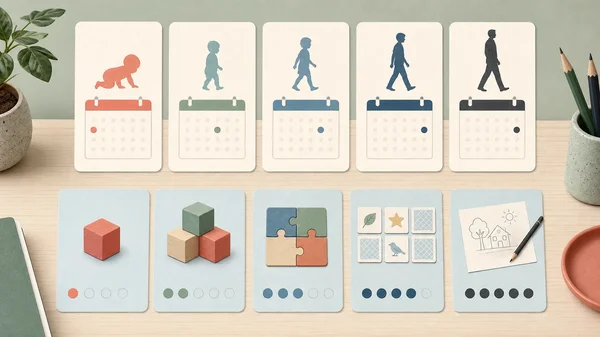
In the Binet-Simon scale, mental age referred to the age level a child could perform at on a sequence of age-graded tasks. If tasks assigned to age eight were generally passed by eight-year-olds, and a child could handle those but not the next age level, the child's mental age might be described around eight. That did not mean the child "was" eight inside. It meant the child's performance on that particular set of tasks resembled the expected performance for that age level.
This is where chronological age becomes important. Chronological age is simply how long someone has been alive. Mental age, in Binet's historical sense, was a performance comparison. According to Binet, mental age relates to chronological age because the gap between the two gave educators a rough signal about whether a child might need extra instruction, different pacing, or more careful attention.
A mental age chart in that era was not a personality wheel. It was closer to a developmental task ladder. The test asked: what can a child do reliably right now, compared with the tasks most children at each age can do? That is why the phrase "to assess mental age Binet and Simon measured children's..." is usually completed with an idea like age-level task performance, not emotional vibe or lifestyle preference.
Modern readers should also notice the humility built into the best reading of this concept. A child could perform differently depending on language, schooling, health, familiarity with tasks, stress, or the examiner's approach. Mental age was useful only if adults remembered those limits.

How to Calculate Mental Age the Historical Way
People often ask how to calculate mental age because the phrase sounds like a simple formula. Historically, the idea began with age-graded tasks. A child's mental age was estimated by finding the highest age level of tasks they could pass consistently, sometimes with credit for additional items above that level.
The later ratio IQ formula made the idea feel even more mathematical:
- Mental age divided by chronological age, then multiplied by 100.
- A child with a mental age of 10 and a chronological age of 10 would score around 100 by that older ratio method.
- A child with a mental age of 12 and a chronological age of 10 would score higher by the same formula.
That formula is associated with the later Stanford-Binet tradition more than with the whole spirit of Binet's original caution. It is useful for understanding history, but it is not how most modern intelligence scores are interpreted. Modern professional tests usually compare a person's performance with age-based norms, rather than treating mental age divided by chronological age as the central calculation.
This matters for online search terms such as mental age calculator and Binet-Simon scale mental age. A calculator can show the old arithmetic, but it cannot recreate the full testing context, the quality of the task design, the age norms, or the professional judgment involved. For casual self-reflection, a playful mental age quiz should be understood as a different kind of experience from the historical Binet-Simon scale.
Binet Mental Age vs Today's Online Mental Age Tests
Today's online mental age tests usually ask about preferences, habits, emotional reactions, humor, decision style, nostalgia, or social energy. They are closer to self-reflection tools than to historical intelligence scales. A result like "your mental age is 28" often means your answers resemble a certain style of maturity, spontaneity, calmness, or curiosity inside that quiz's scoring model.
That can be enjoyable and surprisingly thought-provoking. It just should not be confused with the Binet-Simon test or the Stanford-Binet. The old Binet mental age concept was about children's performance on structured tasks compared with age expectations. A modern mental age test is usually about how you relate to the world: whether you feel young at heart, old-souled, practical, adventurous, cautious, emotionally steady, or playful.
Here is a simple way to keep the difference clear:
- Binet-Simon mental age: age-level task performance in a historical educational setting.
- Stanford-Binet: a professional intelligence testing tradition that developed from Binet's work.
- Online mental age test: a reflective quiz experience about personality-like patterns, attitudes, and self-perception.
- Mental age calculator: a tool that may use either old ratio-style arithmetic or modern quiz scoring, depending on the site.
The overlap is the metaphor of age. The difference is the purpose. Binet used age to make child performance easier for educators to interpret. Modern online quizzes use age to make inner style easier for readers to imagine.
Is the Stanford-Binet Still Used Today?
Yes, the Stanford-Binet tradition is still used today, but it is not the same thing as a casual online mental age result. The modern Stanford-Binet Intelligence Scales are professionally administered cognitive assessments. The fifth edition covers a wide age range, commonly described as age 2 through 85 years, and it looks at multiple areas of cognitive ability such as fluid reasoning, knowledge, quantitative reasoning, visual-spatial processing, and working memory.
So when someone asks, "Is the SB test still used today?" the answer is yes in professional settings, with modern norms and trained administration. When someone asks, "What age is the Binet test for?" the answer depends on which version they mean. The early Binet-Simon age scale focused on children and school performance. The modern Stanford-Binet covers children, adolescents, and adults.
This distinction helps protect you from a common search trap. A phrase such as Binet-Simon Intelligence Scale PDF may lead to historical documents, old item lists, or summaries, but reading a PDF is not the same as being assessed with a modern standardized instrument. The value of the history is understanding how the concept evolved, not trying to self-score from old materials.
A Practical Reading Checklist for Mental Age Results
Whether you are reading about Binet, using a mental age calculator, or exploring a modern online quiz, it helps to slow down and ask a few careful questions.
- What kind of "mental age" is being discussed: historical task performance, professional cognitive testing, or casual self-reflection?
- What was measured: structured problem-solving, age-normed cognitive ability, or preferences and attitudes?
- What age comparison is being used: chronological age, age-level tasks, or a quiz's internal style categories?
- What should the result be used for: educational planning, professional interpretation, or personal curiosity?
- What should it not be used for: labeling your value, judging someone else's maturity, or replacing qualified support when real concerns exist?
This checklist is especially helpful because the words can sound more precise than they are. "Mental age" feels numerical, but the meaning changes across contexts. Binet's mental age, Stanford-Binet scoring, and modern mental age tests all use age language, yet they answer different questions.
Use Mental Age Binet as a Reflection Lens Today
The best modern use of the mental age Binet story is not to copy old scoring or treat yourself like a school record. It is to borrow Binet's practical humility. Ask what your current patterns show, where your strengths appear, and where you might want more support or practice.
If your result feels younger than your chronological age, that might point to playfulness, openness, or a flexible attitude. If it feels older, it might point to patience, caution, or reflective decision-making. Neither is better. Both can be useful depending on the situation.
For a light, private way to explore those patterns, you can use a self-reflection mental age tool as a conversation starter with yourself. Keep the result flexible. Notice what resonates, question what does not, and let the number open a small door rather than close one.
FAQ
What did Binet use the term mental age to refer to?
Binet used mental age to refer to the age level at which a child could perform on age-graded tasks. It was a comparison with typical child performance at different ages, not a statement about the child's inner identity.
How did Binet and Simon measure children's mental age?
They used a sequence of tasks that children at different ages were expected to pass. The child's performance was then compared with those age levels to estimate the child's mental age.
How does mental age relate to chronological age?
Chronological age is the person's actual age in years. In the Binet-Simon context, mental age was the age level suggested by task performance. Comparing the two helped educators notice when a child might need a different kind of support.
Is the Binet-Simon test the same as a mental age test online?
No. The Binet-Simon test was a historical educational assessment built around structured tasks. A modern online mental age test is usually a light self-reflection quiz based on preferences, attitudes, and response patterns.
Is the Stanford-Binet still used today?
Yes. Modern Stanford-Binet assessments are still used in professional contexts, but they are standardized instruments administered and interpreted by trained professionals. They are not the same as casual online quizzes.
What age is the Binet test for?
The early Binet-Simon scale was designed mainly for children in a school context. The modern Stanford-Binet Fifth Edition is commonly used across a much broader age range, from young children through older adults.
Can I calculate my mental age with a simple formula?
You can understand the old ratio idea by dividing mental age by chronological age and multiplying by 100, but that is history, not a complete modern interpretation. Online calculators and quizzes should be treated as reflective tools unless they are part of a professional assessment process.